
What is Activated Carbon?
Activated carbon, also known as activated charcoal, is a form of carbon processed to have small, low-volume pores that increase the surface area available for adsorption or chemical reactions. This material is typically used to purify liquids and gases in various applications, including water filtration, air purification, and industrial processes. The activation process involves treating the carbon material with oxygen to open up millions of tiny pores, enhancing its ability to trap contaminants and impurities. This makes activated carbon a highly effective and versatile material for removing pollutants and toxins from air and water.
How does activated carbon work?
Activated carbon works mainly through a process called adsorption — where molecules from a gas or liquid stick to the surface of the carbon. Because activated carbon has an enormous surface area (one gram can have over 1,000 square meters of surface!), it can trap a huge amount of impurities in its network of tiny pores. There are two main types of pores: micropores (for trapping smaller molecules) and mesopores/macropores (for larger ones). Besides physical adsorption, chemical reactions can also happen on the surface to break down or bind certain contaminants. Overall, activated carbon acts like a highly efficient sponge — but for molecules you can’t even see.
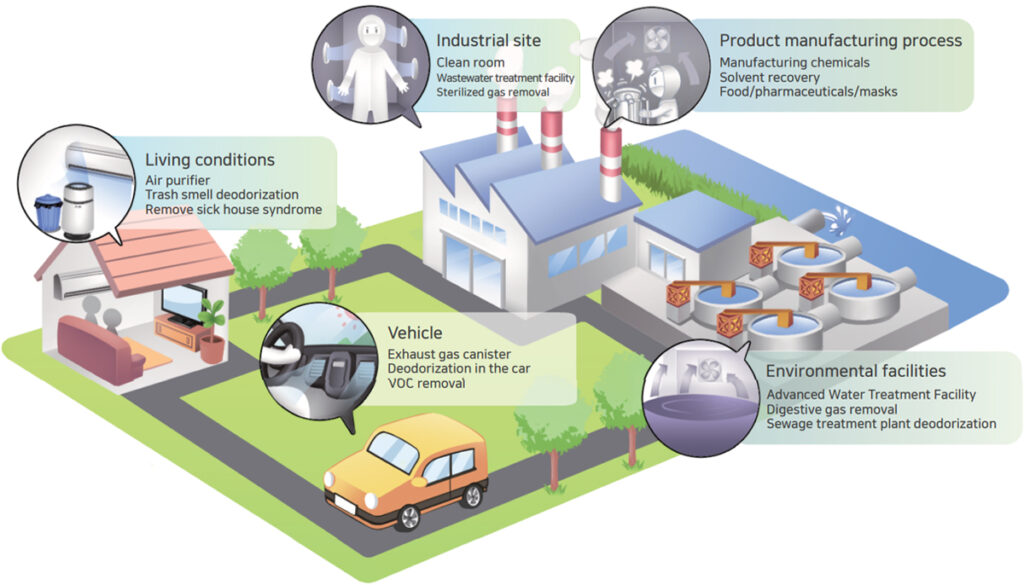
Where is activated carbon used?
Activated carbon is extensively used across industries due to its superior adsorption properties. It plays a vital role in water treatment by removing organic compounds, chlorine, and odors, and is essential in air and gas purification by capturing pollutants such as VOCs and sulfur compounds. In the food, beverage, and pharmaceutical industries, it purifies products by eliminating colors, odors, and impurities. Activated carbon is also critical in gold recovery for mining operations and in chemical processing for purifying liquids, gases, and recovering catalysts. Additionally, it is used in automotive fuel vapor recovery systems and in the electronics industry to purify gases required for semiconductor manufacturing. Its effectiveness is enhanced by tailoring its pore structure to specific applications.